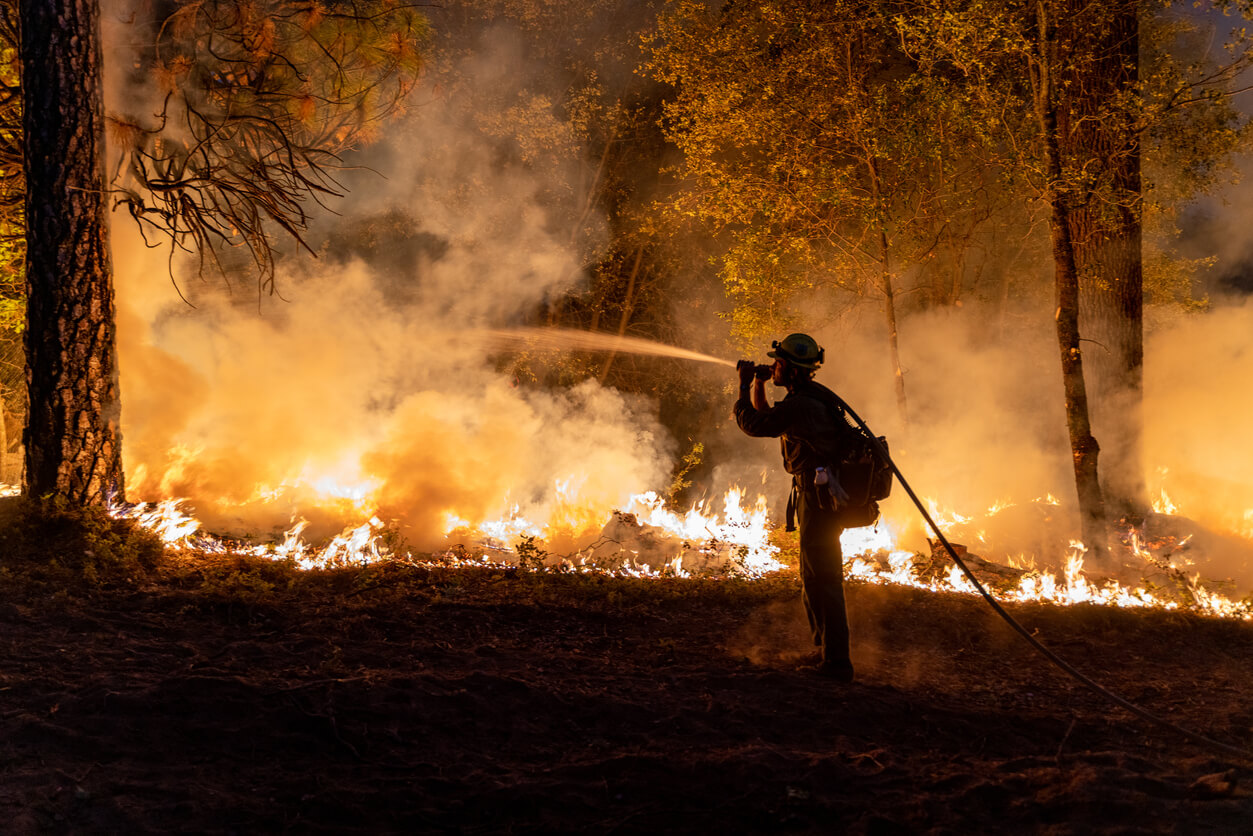
The Senate Subcommittee on Conservation, Forestry, Natural Resources, and Biotechnology convened on Thursday for a hearing to discuss the Fix Our Forests Act (FOFA) and explore solutions to the wildfire crisis.
The Fix our Forest Act aims to improve and scale forest management efforts in the U.S. by simplifying and expediting environmental reviews, minimizing frivolous litigation that causes delays, and adopting innovative tools and strategies.
Earlier this year, Representatives Bruce Westerman (R-AR) and Scott Peters (D-CA) reintroduced FOFA in the House, which passed with an overwhelming majority vote of 279-141. As Matt Weiner, CEO and founder of Megafire Action (a think tank dedicated to solving the wildfire crisis), noted during the hearing, “This is a nonpartisan emergency that requires a bipartisan response… and the Fix Our Forests Act is an excellent start to that.”
Weiner emphasized that FOFA is a crucial first step because it focuses on two key areas that policymakers should address: permitting reform and technology adaptation.
Permitting, specifically the National Environmental Policy Act (NEPA), has long been a barrier to essential forest management efforts. Sarah Rosa, Policy Manager of the American Conservation Coalition Action, pointed out that in 2001 the U.S. Forest Service planned a project to reduce wildfire risk. However, the agency had to abide by NEPA reviews to move forward. By the time the environmental review was completed, over two years later, a wildfire had already burned almost half of the project area. Further, two years is considerably shorter than the typical timeline for a NEPA review. On average, mechanical thinning projects requiring an environmental impact statement (EIS) take 5.3 years to review, while prescribed burns requiring an EIS take 7.1 years.
>>>READ: Grazing as a Strategic Fire Prevention Solution
The Fix Our Forests Act would address key issues in the permitting process by streamlining NEPA reviews, reducing litigation timelines, and expanding the acreage eligible for categorical exclusions (projects exempt from EIS or EAs) from 3,000 acres to 10,000.
A key component of technological adaptation, Wiener’s second key focus, in FOFA is establishing an interagency Fireshed Center, which will enable states better to tailor their forest management strategies to their individual needs. The Center will assess and predict fires through advanced data integration, science-backed services, and innovative technologies. It will also streamline processes and provide publicly accessible data, models, and tools to support more effective wildfire prevention and response.
>>>READ: Understanding Climate Change’s Impact on the Los Angeles Wildfires
Weiner noted that the bill would also drive private sector innovation by creating a wildfire technology testbed program. This pilot program would promote collaboration on new and innovative wildfire prevention, detection, communication, and mitigation technologies, and bring together land management agencies such as the Departments of the Interior and Agriculture.
Over 117 million acres of federal land in America are overgrown, fire-prone, and need active forest management. We can’t keep neglecting our forests and expect different results. From 2015 to 2024, the Forest Service, Department of the Interior, and FEMA allocated over $38 billion to fire response, yet only $6 billion went to vital prevention efforts.
A recent analysis by Vibrant Planet found that a $76 million investment in forest treatment could result in $2.85 billion in avoided losses, a $2.1 billion return on investment. The choice is clear: act now to fix our forests, or pay a steeper price later. The committee should act swiftly on this bill, ensuring that vital forest management efforts remain a priority.