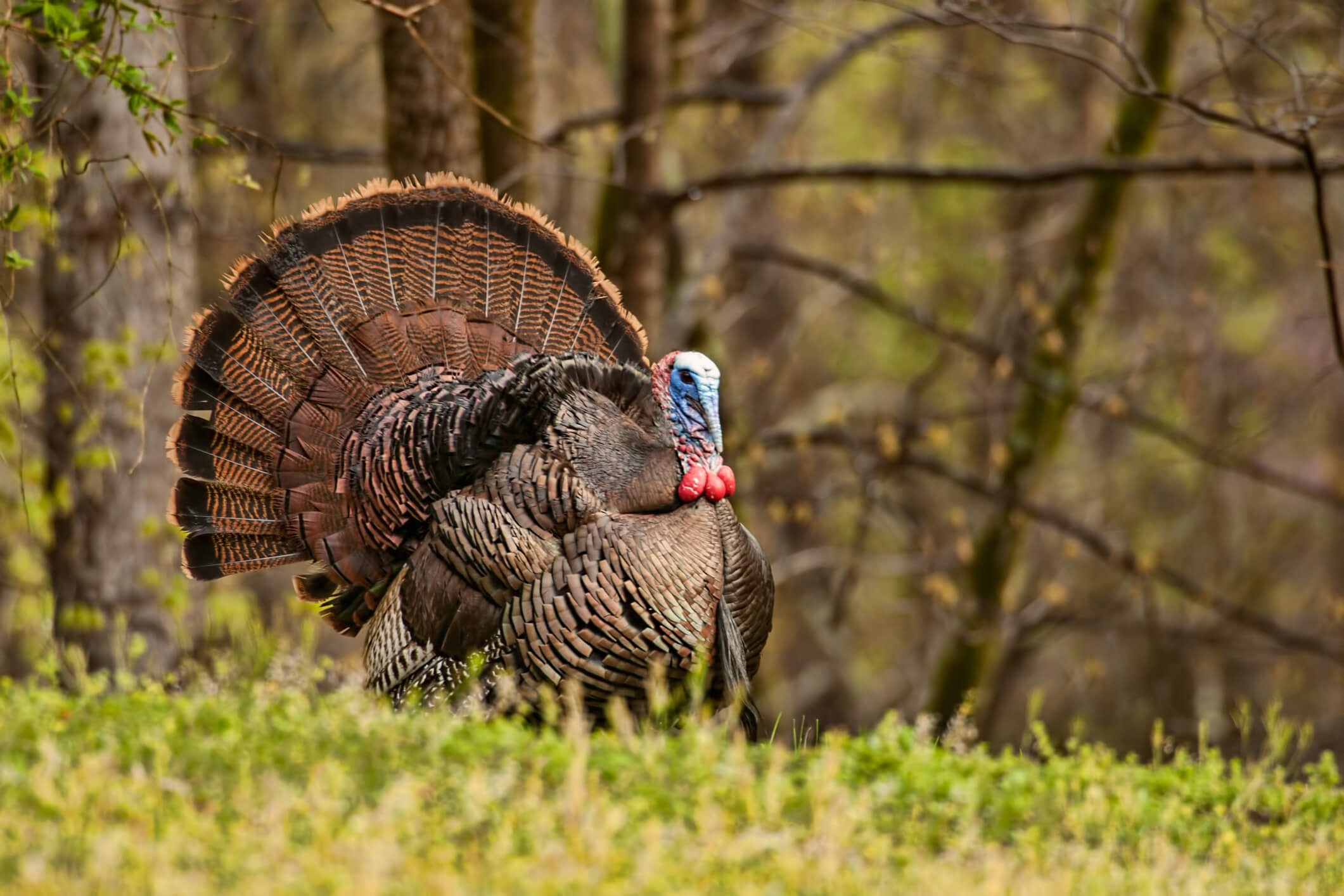
Most Americans only think about turkeys once a year, when Thanksgiving rolls around. We often take for granted that there will be a bird at the grocery store in exactly the size and weight we want. But what many don’t know is that wild turkeys, the domestic turkey’s ancestor, were once nearly wiped out across much of the United States due to overhunting and habitat loss. By the early 1900s, biologists estimate that only around 30,000 wild turkeys remained on the entire continent.
In many states, wild turkeys vanished entirely from the environment. They were gone from parts of the Northeast and Midwest where they had been a defining feature of the woods. Logging and land clearing stripped away the mix of mature forest and open fields the species needs to survive. At the same time, there were few limits on hunting, and market demand for wild game pushed remaining populations to the brink.
Despite their bleak history, wild turkeys are among the greatest conservation stories in America. Their comeback began when states started regulating hunting through defined seasons and bag limits that gave surviving flocks space to recover.
Then, in 1937, Congress passed the Pittman-Robertson Federal Aid in Wildlife Restoration Act, which placed an excise tax on firearms and ammunition and sent the proceeds to state wildlife agencies for habitat restoration, research, and hunter safety and education. Although hunters and other firearm owners paid the tax, it was widely supported by conservation and sportsmen’s groups, who knew dedicated funding was essential to restoring species like the wild turkey. States used those dollars to rebuild forests and wetlands and to establish the institutions of modern wildlife management.
The tax helped fuel their comeback, but wildlife biologists also experimented with new tools and techniques, from better survey methods to targeted habitat work. The most effective was the “trap and transfer” model that came to define turkey restoration.
Using rocket-fired nets–which launch a net over birds quickly and safely– agencies captured wild turkeys from healthy populations and relocated them into empty habitats in other states to repopulate. That approach worked because landowners were willing partners. Farmers, ranchers, and private forest owners had plenty of reasons to help, including allowing trapping on their land. Many were hunters themselves or lived in communities where turkey hunting was vital to the economy and livelihoods. Improving habitat also made their land healthier, whether by supporting timber growth or restoring fields and woodlots.
Importantly, hosting wild turkeys on their property did not trigger penalties or land-use restrictions. That stands in sharp contrast to today, when landowners with endangered species on their property face complex regulations that limit how they can use their land, which in turn disincentivizes conservation.
From a low of roughly 30,000 birds in the early 20th century, wild turkey numbers climbed into the millions as restoration took off in the 1950s through the 1970s.
Today, an estimated 5 to 7 million wild turkeys are spread across 49 states, and hunting seasons are open almost everywhere except Alaska. The National Wild Turkey Federation describes the wild turkey as one of the greatest wildlife comeback stories of the last century. The bird that once vanished from many states is now common enough to show up in backyards.
The wild turkey’s comeback, supported by Pittman-Robertson funding, happened because of voluntary, science-based collaboration and respect for private property rights. Federal policy created a stable funding stream, but recovery depended on people willing to work together — state biologists, hunters, conservation groups, and private landowners.
That cooperative model is what modern wildlife laws should deliver. The Endangered Species Act, for example, was designed to recover species so they no longer need federal protection. But 97 percent of species ever listed are still on the list and have yet to reach recovery. For many landowners, having an at-risk species on their land can trigger regulatory uncertainty. Instead of inspiring stewardship, the law often makes people cautious about helping to conserve the species at all.
As the wild turkey shows, conservation accelerates when restoring a species benefits the people who manage the land. The species rebounded on farms, ranches, and private forests because landowners viewed restoration as an asset, something that improved their land and communities.
As Congress considers updates to endangered species protections, such as the ESA Amendments Act, the turkey offers a useful lesson. Recovery is most effective when policies reward the behaviors that actually help wildlife: habitat restoration, collaborative management, strong partnerships. The ESA Amendments Act would shift the status quo toward this kind of approach by emphasizing recovery and encouraging voluntary conservation. Making conservation easier for landowners is essential if we want more stories that look like the wild turkey’s.
As we celebrate Thanksgiving, we should remember the wild turkeys, too. Their comeback shows that when voluntary stewardship is prioritized, wildlife recovers. More species could do the same if policy encouraged that kind of stewardship.