By Drew Bond
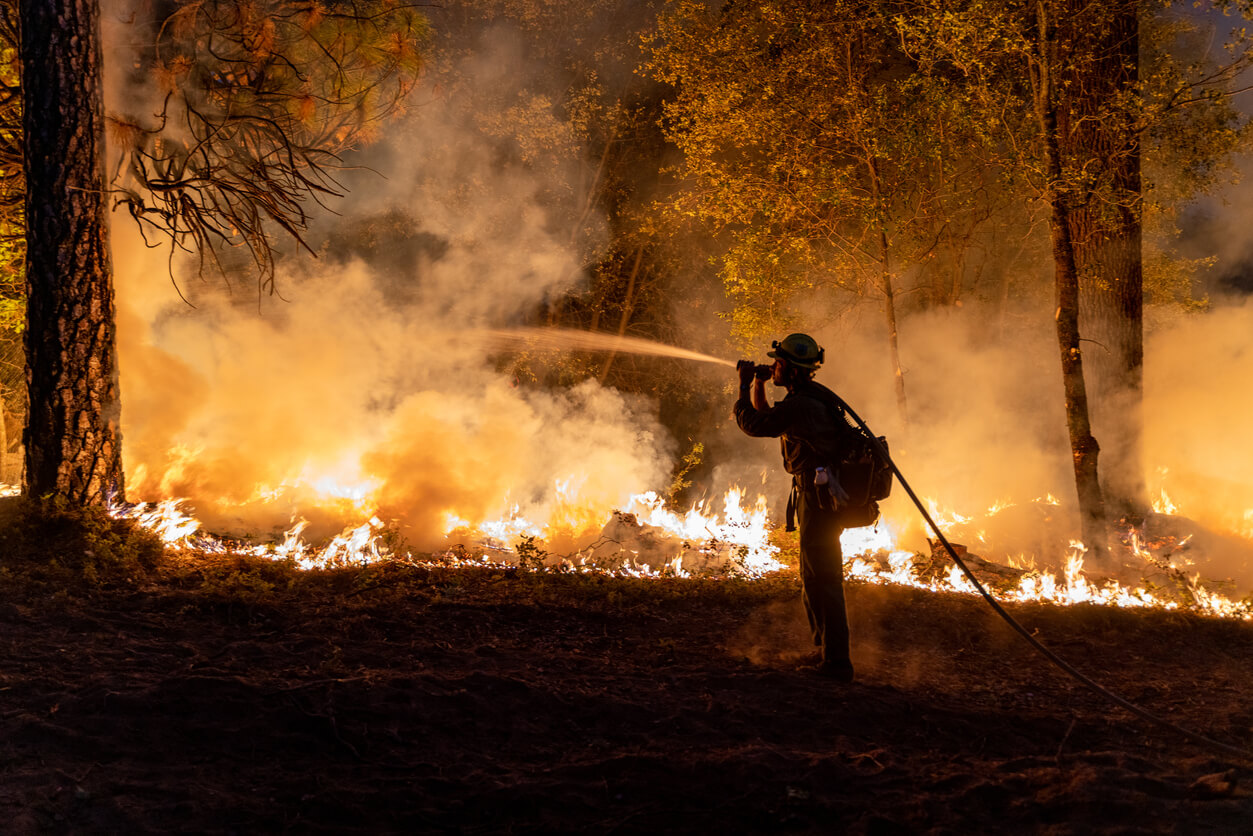
California is burning. Even in September, after summer had supposedly ended and Golden State residents had reason to expect a break from that season’s heat and destruction, wildfires were swallowing 1,000 acres every half hour.
The National Park Service says, “Most of California remains under the threat of unprecedented and dangerous fire conditions with a combination of extreme heat, significant wind events, dry conditions, and firefighting resources that are stretched to the limit.” As firefighters try to stop the flames, more than 170,000 people were left without power during a heatwave, after the electric utility turned off the juice to prevent a risk of further fires.
Of course, the fires threaten not only property, but also people. “Pilots wearing night-vision goggles landed helicopters in California’s burning Sierra National Forest to save 164 people trapped by flames and were working to rescue 17 others,” Axios reported on September 9. At least eight people have been killed.
Perhaps the worst part is that it doesn’t need to have been this way.
The public interest Web site ProPublica, not a particularly conservative website, explains that firefighters know how to reduce the risk: set controlled burns that eliminate fuel for wildfires. Malcolm North, a research ecologist with the U.S. Forest Service who is based in Mammoth, California, told ProPublica he’s not aware of “any meaningful scientific dissent to the idea that we need to do more controlled burning.”
But the problem is that policymakers, who profess concern about the environment and to push reliance on science, don’t seem to be following their own advice.
“Planned burns are human-made events and as such need to follow all environmental compliance rules. That includes the Clean Air Act, which limits the emission of PM 2.5, or fine particulate matter, from human-caused events,” ProPublica writes. “In California, those rules are enforced by CARB, the state’s mighty air resources board, and its local affiliates.” Sometimes, a planned burn will be blocked by these regulations just as it’s about to begin, costing the state thousands of dollars and leaving millions of acres at risk.
Policymakers at the state and federal level are pursuing a “zero burn emissions” policy. They would rather pretend that they will have the ability to extinguish wildfires than to admit that they need to eliminate fuel through controlled burns before fire season starts. However, by leaving fuel around for wildfires to consume, the state’s policies end up increasing net carbon emissions and the destruction of property when wildfires do erupt.
“With prescribed burns, people can plan ahead: get out of town, install a HEPA filter in their house, make a rational plan to live with smoke,” ProPublica writes. With wildfires, nobody knows where or when they will break out.
The problem isn’t the intention: everyone wants to prevent emissions. The problem is the outcome. Wildfires mean more emissions and the destruction of property. Everybody loses.
We need public policies that unlock solutions and protect people and property. The federal and state governments should be encouraging tried and true, as well as innovative, approaches to today’s problems. When it comes to fire prevention, that will require controlled burns to eliminate fuel for wildfires. When it comes to energy policy, it means an “all of the above” approach that makes various sources of energy more abundantly available with cleaner and cleaner outcomes in years to come. Cooler, wetter weather will eventually arrive in California and help extinguish this year’s fires. It’s not too soon to start thinking about next year, though, and start planning the controlled burns we’ll need if we want to reduce future risks.