With constant talk of an imminent and inevitable energy transition, recently released projections from the U.S. Energy Information Administration (EIA) provide another reminder of why that terminology may not quite reflect reality. A more appropriate phrase for the world’s outlook is “the energy expansion.”
>>>READ: Hamas and the Folly of Energy Dependence
More energy is necessary to address energy poverty. More than 600 million people in Africa do not have access to electricity and the population on the continent may nearly double to 2.5 billion people by 2050. Asia’s Development Bank reports that more than 350 million people have limited access to electricity, and 150 million people have no access. Reducing household energy poverty is a priority but so too is providing the necessary power for emerging economies to develop.
More energy is necessary for greater energy security. Half a century after the 1973 oil crisis, energy security remains at the forefront of international dialogue. Russia’s invasion of Ukraine in 2022 reminded the world how energy can be weaponized and the Israel-Hamas war could have implications for energy production in the Middle East.
And more energy is necessary for greater productivity. Even with significant efficiency gains, new technologies will shift the supply and demand curves for energy. For instance, “by 2027 A.I. servers could use between 85 to 134 terawatt hours (Twh) annually,” the New York Times reported, citing a recent study. “That’s similar to what Argentina, the Netherlands and Sweden each use in a year, and is about 0.5 percent of the world’s current electricity use.”
Solving these challenges requires more energy. As the EIA projects in its latest International Energy Outlook, fossil fuels and non-fossil fuels will be essential to meeting that demand.
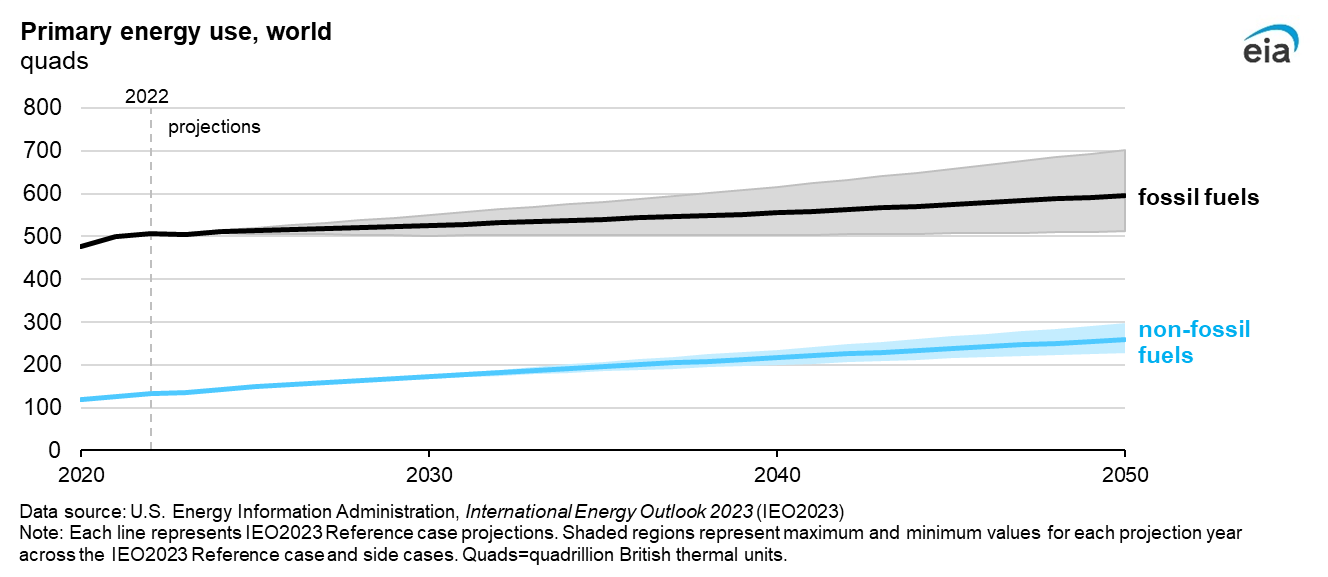
EIA says:
Our projections highlight a key global insight—global energy-related CO2 emissions will increase through 2050 in all IEO2023 cases except our Low Economic Growth case. Our projections indicate that resources, demand, and technology costs will drive the shift from fossil to non-fossil energy sources, but current policies are not enough to decrease global energy-sector emissions. This outcome is largely due to population growth, regional economic shifts toward more manufacturing, and increased energy consumption as living standards improve.
In a 70-page report full of useful information and findings, this takeaway alone is significant for several reasons. The first is to note the tradeoff of rising emissions and higher living standards and levels of prosperity. Most people would say that’s a worthwhile tradeoff. Californians use more energy playing video games and heating their swimming pools than some African nations have access to. In a given year, a household refrigerator in the U.S. uses more power than the average individual in Kenya, Nigeria, Tanzania, the Democratic Republic of Congo, and Ethiopia. Access to energy is a taken-for-granted privilege. Expanding energy access, even if it comes at the cost of increasing emissions, should be a global priority.
Notably, the scenario in the EIA report where emissions decline is the Low Economic Growth case. That is effectively the degrowth mentality that traps people in poverty, restricts access to energy, and purposely constrains levels of prosperity and human well-being. That’s not a viable option.
>>>READ: In Defense of Green Growth
That is not to suggest, however, that we should summarily dismiss the risks and costs of rising emissions. Decoupling economic growth from emissions has occurred in many developed countries, and it can happen faster in developing countries as the cost of low and zero-emission technologies decline. Encouragingly, global energy transition investments in 2022 totaled $1.1 trillion. It’s the first time this investment was equal to the amount invested in fossil fuels. Whether it is renewables, batteries, geothermal or nuclear, making these energy sources cost-competitive will be essential to their wide-scale global deployment.
Being conscious of future energy needs while tackling climate ambitions is a matter of policy debate. In the U.S., with subsidies in the Inflation Reduction Act and regulations on power plants, vehicles, and appliances, the Biden administration is heavy on both the carrots and the sticks. This approach is running into two fundamental problems.
The first is what the Breakthrough Institute’s Alex Trembath calls “cost-disease environmentalism.” Writing in City Journal last year, Trembath writes, “subsidizing demand for low-carbon technology comes with serious risks if policymakers don’t attend to the supply side by dismantling the regulatory bottlenecks that make it hard to build anything in this country.” Despite some marginal reforms, Congress has not come close to addressing those regulatory (and litigation) bottlenecks that could help improve outcomes on a wide range of energy and environmental priorities – everything from small modular reactors to forest management.
The second problem is what journalist Josh Barro labeled “the hamburger problem.” Barro warned liberals in 2017 that they are “too ready to bother too many ordinary people about too many of their personal choices, all the way down to the hamburgers they eat.”
Americans see this in federal and state policy in things such as attempts to phase out the internal combustion engine. They see it when wealthy elites tell everyone else to eat less meat and travel less, while doing so from their yachts. Policymakers and Western societies must be cognizant of these realities and promote climate solutions that lower costs and improve livelihoods for emerging economies around the world.
Successful energy and climate policies should liberate producers and innovators to provide consumers with what they want as opposed to policymakers and regulators dictating to consumers what they think they should have. Pro-growth tax policy, permitting reform, and enabling more investment and trade will drive bottom-up solutions that increase energy availability and reduce the risks of climate change. A global energy expansion should improve our outlook for people and the planet.