Not long ago, most countries just focused on the bottom line: Gross Domestic Product. A positive GDP meant a growing economy. But there is a new factor in play these days. Countries need economic development, but they also demand green growth. Countries, and their leaders in particular, are looking for ways to grow sustainably. But what does “sustainable” actually mean? Can we really measure it? It’s important to consider that for something to be sustainable, or sustained over time, it must be beneficial. No country can afford to invest in green energy if doing so leads to economic losses. Everyone needs to find both things: green growth and greater GDP.
Many countries are succeeding at threading that needle. However, the solutions will look different from country to country, region to region, and continent to continent.
>>>READ: In Defense of Green Growth
Still, the best way to encourage green growth is by allowing people to live and work in economic freedom. A country’s commitment to economic freedom results in more wealth and human progress, which increases the available resources and technologies to invest in environmental protection. Free economies are clean economies where people and planet alike can flourish. This is true at the macro level, as our Free Economies Are Clean Economies report shows in great detail.
At the micro level, however, economic freedom manifests in different ways.
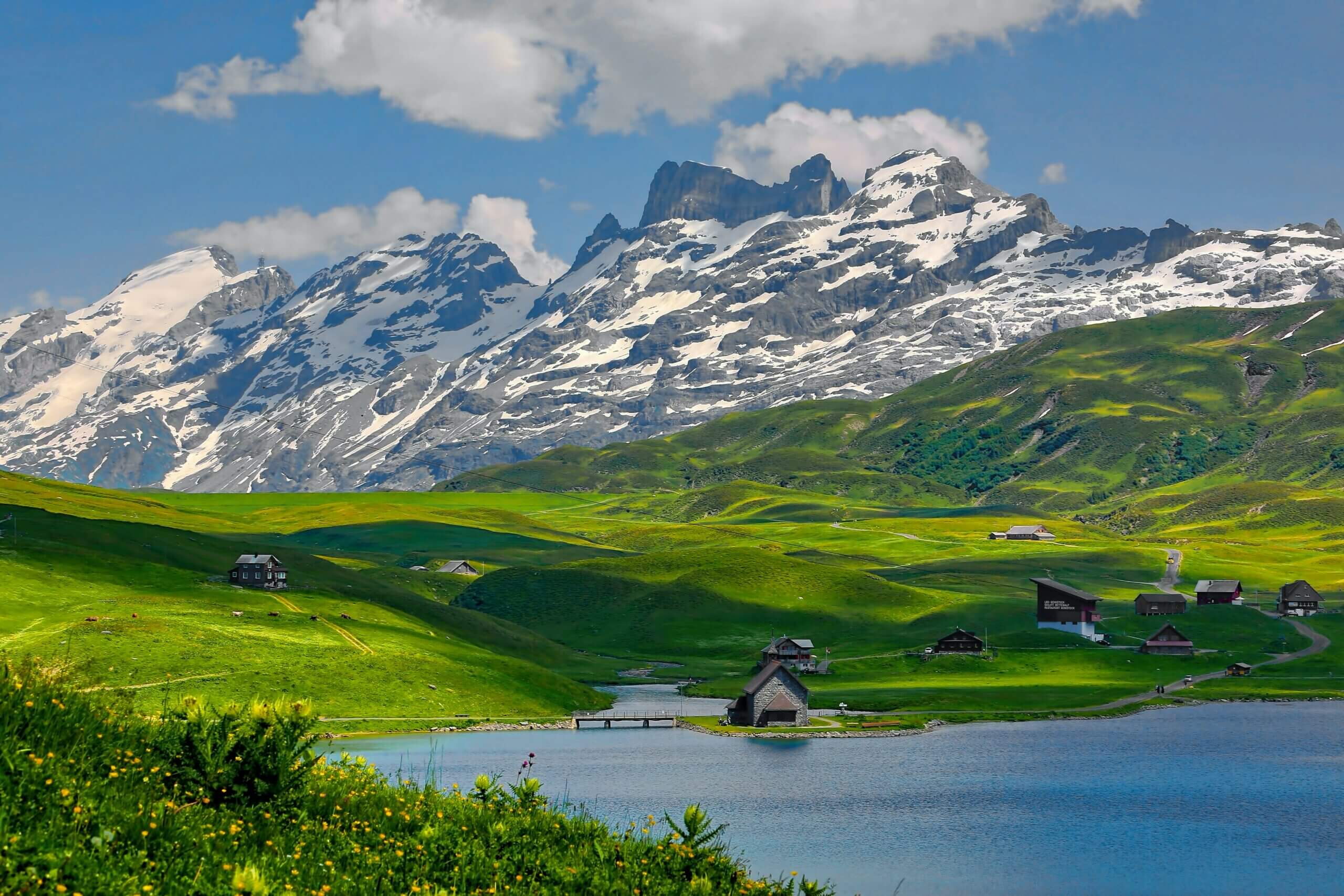
Consider Switzerland, an advanced economy that is taking steps to promote a green transition. Switzerland is a leader in economic freedom, with a score of 83.8 on the Heritage Foundation Index of Economic Freedom. That earns it a rating of “Free.” It is a “modern market economy,” with an annual GDP growth rate of more than 2%. It is also putting into place plans that can contribute to a cleaner global future.
“Predictable, innovation-friendly national framework conditions and a firm and voluntary commitment by the economy and society are necessary to successfully transition to a green economy,” the Swiss government explains. A key word there is “innovation.” Economic freedom means encouraging people to innovate: creating new types of batteries, new sources of energy, and new ways to dispose of unwanted byproducts such as carbon dioxide.
It is important to have a government that sets goals. “The measures set out in the Energy Strategy 2050 to improve energy efficiency in all sectors as well as its cross-cutting information and market-based instruments are essential to the transition to a green economy,” the Swiss government writes. As long as the goals encourage freedom and do not lead to coercion, they can be a net positive.
Meanwhile, the country recognizes it will need more energy in the years ahead even as it works to achieve the sustainable use of resources. Switzerland’s energy usage per capita, for example, jumped 112% last year.
>>>READ: Economic Cooling Won’t Stop Global Warming
“Resource-conserving consumption and production models can only be achieved by commitment from government, including cantons and municipalities, and all sectoral policy areas, the private sector, science and the whole of society,” the government writes.
Again, though, deploying economic freedom will be key. The way to unlock the power of society and the private sector is by giving people the freedom to innovate. Strict federal mandates are a path to failure.
Later this month, world leaders will gather at the annual United Nations Climate Change Conference. COP 28 begins November 30 in the United Arab Emirates. As we have in recent years, the Conservative Coalition for Climate Solutions will be there to host events that promote the importance of economic freedom. Our message is getting through, in Switzerland and in growing countries that want to be the next Switzerland.